MVP Product Engineering in 2026: The Stack I Recommend to Startups
Most MVPs don't get killed by competitors. They die at home, quietly, somewhere around month four — the build dragged, the money thinned out, the founder's energy went into fighting infrastructure instead of talking to users. I've been freelancing for fifteen-plus years and I've seen this movie enough times to recite it.
The stack won't save a bad idea. But the wrong stack absolutely can kill a good one. So here's what I actually recommend to founders, and the reasoning, including the part where I tell you when to ignore me.
The only three questions that matter
Forget benchmark wars. For an MVP, I care about exactly three things. How fast do we get to the first real user, because every week before launch is a week of guessing. How much operations work does it create, because a two-person startup babysitting servers is a tragedy. And does the stack have a dead end in it, because "we'll rewrite it later when we have traction" is a sentence that has ended more startups than any competitor ever has.
The stack
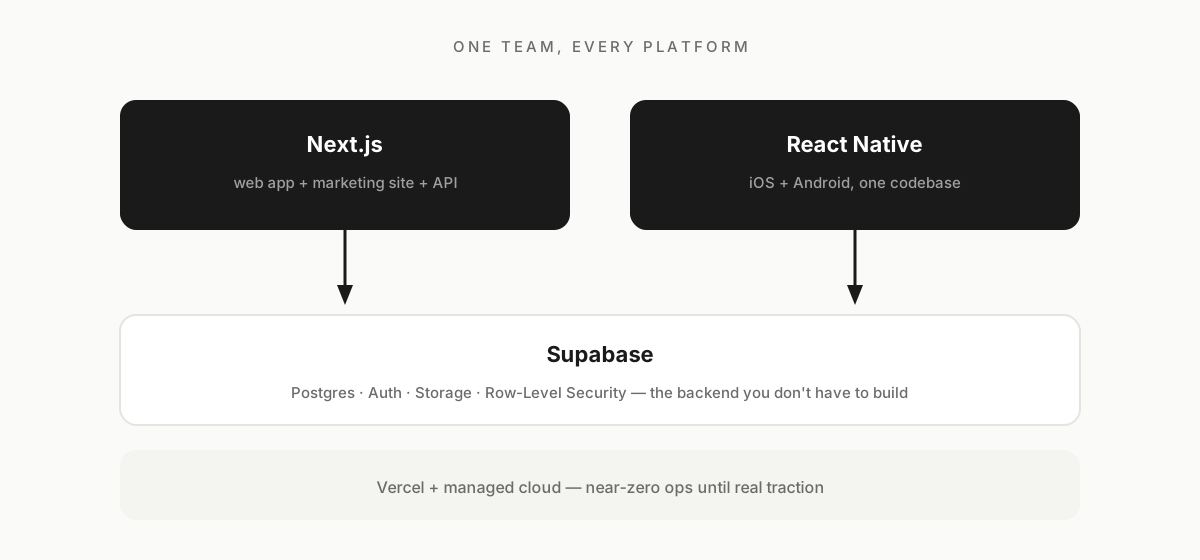
Next.js, because one codebase beats two
Your marketing site, your web app, and your API in one project with one deploy. That's not a technicality — it deletes an entire category of coordination work at exactly the stage when you can least afford it. I built RezforYou this way: a two-sided booking marketplace, consumer flows and business management, all one Next.js app. It's live, in front of real Turkish salon customers, and there was no "frontend team waiting on the backend team" because there were no teams to wait on each other.
Supabase, because your backend is not your product
Postgres, auth, file storage and row-level security, without writing a backend from scratch. The part I actually care about: underneath the nice tooling it's just Postgres. A boring, thirty-year-old, battle-hardened database you will never outgrow and can take anywhere. No proprietary data model holding your business hostage. That's the "no dead ends" box, ticked.
React Native, because you can't afford three codebases
When the product needs to live on phones, React Native gets you iOS and Android from one codebase, written in the same React your web app already uses. Same language, same mental model, native apps. At MVP stage, the alternative — separate Swift and Kotlin builds — is how you turn one product into three engineering projects.
When I'd tell you to ignore all of this
A content site with an editorial team? WordPress, still, no shame in it — I build those too. A game, heavy video processing, an ML pipeline? Different conversation entirely. And if your team already ships fast in Rails or Laravel, keep shipping. A stack your people know beats a stack a blog post recommended, every single time. Including this one.
The pattern, when it works
Weeks to a working product instead of quarters. One engineer covering web, mobile and backend. Hosting bills that stay near zero until there's real traction to pay for them. And no rewrite lurking at the end, because the MVP stack and the production stack are the same stack.
That's what "product engineering" means on my projects page: building the small version with the same care as the big one. If you're planning an MVP and want a realistic take on scope and timeline before you commit money to it, book a free consultation. Worst case, you leave with better questions.