How I Use Claude AI in Real Client Projects (and What It Changes About Hiring a Developer)
"So can't ChatGPT just build this?"
I get this question a lot now. At dinner, from clients, once from my barber. And the honest answer is more interesting than yes or no, because I use AI every single working day — Claude, specifically — and it has changed how I deliver projects more than anything since I stopped uploading files over FTP.
But it hasn't changed it the way the hype says.
What actually changed
The thinking is still the job. The typing mostly isn't.
That's the whole shift, in two sentences. When I know exactly what needs to be built — the data model, the edge cases, what happens when the user does the weird thing — Claude turns that specification into working code far faster than my fingers ever could. What it cannot do is know those things for me. Nobody's prompt is a substitute for having watched software fail in production for fifteen years.
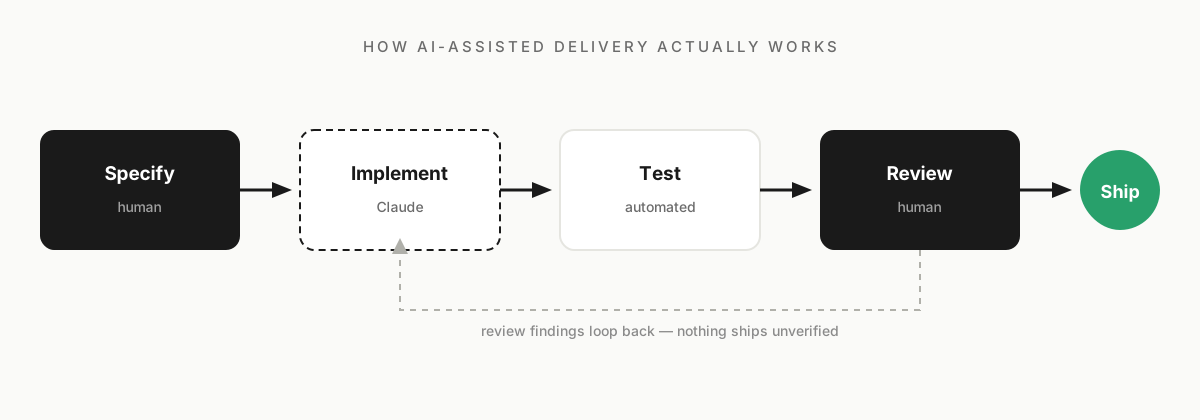
This spring I built a native macOS time-tracking app in Rust. I like Rust; I don't write it every day. A few years ago that project alone would have been months of my life. With Claude handling the implementation while I handled the decisions, it shipped in a fraction of that, alongside a full client portal in Next.js and Supabase. Every task specified up front. Everything tested. Everything reviewed before merging. The speed came from AI. The correctness came from process, and the process is mine.
Where it shines, where it face-plants
AI is brilliant at well-specified features, at writing the thorough test coverage that every deadline-crushed freelancer in history has quietly skipped, and at big mechanical refactors that used to eat a week and my will to live.
It is useless — worse than useless, confidently useless — at knowing what to build. It won't tell you your feature is solving the wrong problem. It won't push back on an architecture that will hurt you in month six. And it will happily produce code that looks immaculate and is subtly wrong, which is why my rule is boring and absolute: nothing ships unverified. Not my code, not Claude's.
What this means if you're hiring
Two things, and they point the same direction.
You should expect more for your money now. Work that took a small team a quarter is often a few weeks for one experienced engineer with a good AI workflow. If a proposal lands on your desk in 2026 and reads like it was scoped in 2022, ask why.
And experience matters more now, not less, which surprises people. AI is an amplifier. Point it well and you get clean, tested, maintainable software at remarkable speed. Point it badly and you get impressive-looking problems, delivered faster than ever. The bottleneck moved from writing code to knowing what good code looks like. That part still takes the fifteen years.
Curious what this looks like on a real project? Have a look at recent builds, or let's talk.